AI hasn’t given businesses more personality, it’s quietly stripped a lot of it out. Pubs sound like florists, blog posts sound like ChatGPT wrote them, and promotional graphics all share the same visual fingerprints, because most businesses ask AI for something generic and then publish whatever comes back first. The fix isn’t less AI. It’s more judgement.
In this post:
- Why a dozen different promotional graphics can still look the same
- What Canva already taught us about this, years before AI
- The tell-tale fingerprints AI leaves on faces and Facebook posts
- Why creating something isn’t the same as communicating something
- How Facebook likes get mistaken for actual results
- A simple test to run before you publish anything AI has made for you
I’m going to say something that might sound slightly odd coming from somebody who uses AI every day.
A lot of businesses are using AI terribly.
I’m not talking about using ChatGPT to help research an article, explore an idea, challenge an argument, tidy something up or help you think through something you’re struggling to explain.
I do all of that.
I’m talking about asking AI to create your marketing for you, accepting whatever comes back first, and publishing it as though the job is done.
There’s a difference.
And increasingly, you can see it.
You can often read a Facebook post and think, ChatGPT wrote that.
You can open a blog post and get halfway through the first couple of paragraphs before thinking, Yep. AI.
You can look at a promotional graphic and immediately recognise the same sort of visual fingerprints.
The businesses, events, colours, pictures and words are all different, yet somehow the end result still starts to feel the bloody same.
Look at the graphics
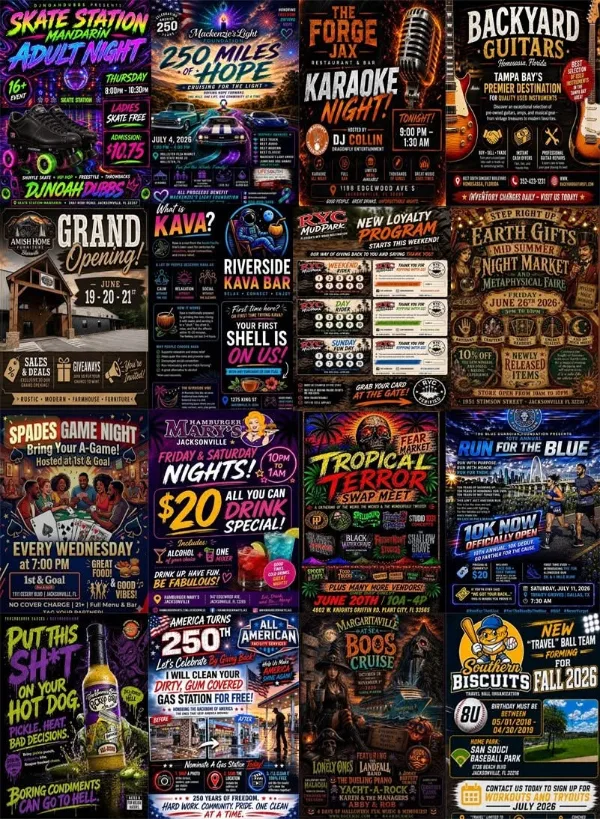
I recently put twelve examples of promotional graphics together on one screen.
They weren’t all advertising the same thing. They contained different imagery, different wording and different colours. Some were events, some were promotions, some were businesses trying to get people through the door.
Technically, they were all different.
But step back from the screen for a moment, go on, do it, and look at the overall thing.
They all looked remarkably similar.
Not identical. That would be a daft claim.
They had the same characteristics.
Big attention-grabbing headings. Lots of visual elements competing with each other. Decorative type. Bright colours. Effects. Glows. Illustrations. Backgrounds. Badges. Little boxes containing bits of important information.
Everything trying to shout at once.
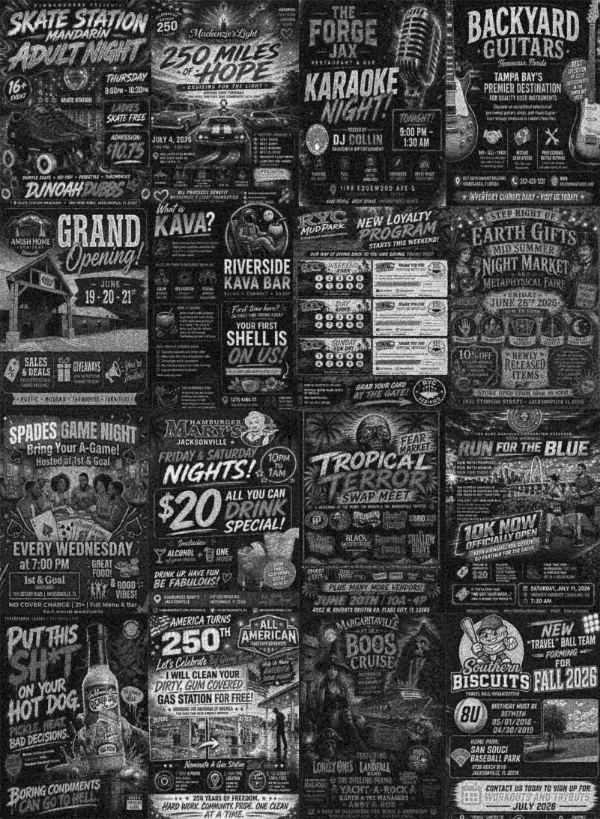
I actually took the colour out of the collection and looked at the twelve graphics in monochrome.
That was interesting.
Without the colours distracting from what was underneath, the similarities became even more obvious.
Different graphics, but the same sort of visual grammar.
That’s probably the best way I can describe it.
And we’ve seen this before.
We did it with Canva
Several years ago I started noticing something similar with Canva.
Before somebody jumps on me, I know Canva contains an enormous number of templates and gives people plenty of freedom to create things themselves.
That isn’t the point.
Certain Canva graphics simply started to look like Canva graphics.
There was somebody I worked with many years ago, who I still work with today, and every now and again she’d put something online and I’d message her jokingly:
You’ve been busy in Canva again.
She’d reply:
Yes.
I could tell.
I wasn’t recognising an identical template. I was recognising the familiar Canva characteristics.
Certain layouts, type choices, combinations of graphics and general design styles started becoming familiar.
AI has taken that to another level.
What makes it slightly ridiculous is that generative AI should theoretically make this problem disappear.
We’re no longer choosing between a selection of templates.
AI can generate almost endless variations of layouts, images, compositions, styles and ideas.
Yet somehow we’ve managed to use technology capable of extraordinary variation to create mountains of stuff that all feels strangely similar.
That takes some doing.
We’ve seen it with AI faces too
Go back a few years in AI image generation and the same thing happened with portraits.
You could generate completely different people.
The faces, hair, ages, clothes and backgrounds could all be completely different, yet you could still often recognise the same AI characteristics underneath.
There was often something about the skin, the lighting, the eyes, the strange perfection, the depth of field or that slightly synthetic polish.
You didn’t necessarily know exactly why, but you looked at the image and thought:
That’s AI.
Different person. Same fingerprints.
AI-generated business content has developed its own fingerprints too.
And it’s not only graphics.
Then there are the Facebook posts
You’ve probably seen these.
🎉 Exciting news! 🎉
✨ We’re thrilled to announce…
🔥 You won’t want to miss this!
📍 Save the date!
👉 Tag someone who needs to know!
Throw in a couple of hearts, perhaps a rocket, a pointing finger, a tick, a telephone and whatever other emoji ChatGPT has decided makes a local business sound exciting that afternoon.
Any one of those phrases or emojis is harmless enough. Use them all in the same familiar way, though, and everybody starts sounding the same.
A pub sounds like a florist.
A florist sounds like a garage.
A garage sounds like a café.
A café sounds like a beauty salon.
Different businesses, run by different people, with completely different personalities and customers.
Yet somehow they all end up sounding like the same overenthusiastic marketing assistant.
That’s where I think businesses should start asking themselves what they’re actually gaining.
You’ve spent years building a business people recognise.
People get to know you over time. They know how you talk, what sort of business you run, what the place feels like and whether your personality is formal, funny, straight-talking, eccentric, traditional, technical or somewhere in between.
That’s your identity.
Then you ask ChatGPT:
Create an engaging Facebook post promoting our event.
You copy it.
You paste it.
You publish it.
And your personality disappears.
Creating something isn’t the same as communicating something
This is probably my biggest problem with some of the AI-generated promotional graphics I see.
They can look impressive.
There’s lots going on.
The colours are dramatic.
The heading is big.
The imagery might be quite good.
Perhaps it has a guitar flying through flames while fireworks explode behind a giant neon title.
Lovely.
Now tell me where the bloody event is.
What time does it start?
How much does it cost?
Do I need a ticket?
Where do I get one?
Is there a website?
Can I phone somebody?
What’s the address?
Sometimes all that information is technically there.
It’s just buried inside the artwork.
Now I’m pinching and zooming around an image on my phone trying to find out whether I need to be there at seven or half past eight.
Why?
You’re a business trying to get me to do something.
Make it easy.
If the important information is fighting with ten decorative elements, some stylised typography and an AI-generated illustration, the design isn’t helping you communicate.
It’s getting in the way.
AI has simply made it incredibly easy to create bad communication that still looks polished.
AI lets people make something that looks designed
Before tools like this existed, somebody with no design experience might have made a fairly basic Facebook post.
LIVE MUSIC SATURDAY
8pm
Free entry
The Red Lion
High Street
Call us on…
It might not win any design awards.
But I know what’s happening.
Now the same person can ask an image generator to create an eye-catching professional promotional poster.
Thirty seconds later, they’ve got something with lighting effects, illustrations, giant type, decorative panels and fifteen things competing for attention.
It looks more sophisticated.
But does it communicate better?
Not necessarily.
AI has given people production capability without automatically giving them communication judgement.
Those aren’t the same thing.
And then we mistake likes for success
This is another trap.
You put your shiny AI graphic on Facebook and it gets 43 likes.
Brilliant.
People must love it.
Maybe.
They might simply like you, know the business or your family, have been customers for years, or just want to show a bit of support for what you’re doing.
That still tells you nothing about whether they studied the graphic, read the wording, found the date or actually bought anything.
A Facebook reaction is very easy to misread as proof that the content worked.
It proves somebody pressed a button.
That’s about it.
If your objective is to sell tickets, get somebody into your shop, generate enquiries, get people onto your website or encourage somebody to phone you, that’s what you should be thinking about.
Not whether the graphic collected some thumbs-up icons.
You see the same thing in blog posts
Ask ChatGPT to:
Write me a 1,500-word blog post about the benefits of…
and accept the first answer.
There’s a fair chance it’ll be perfectly readable.
It may even be technically accurate.
It’ll probably have headings.
It’ll probably sound polished.
And it may contain absolutely nothing that could only have come from you.
It may contain none of your experience, opinions, curiosity, stories or particular insight, and give the reader very little reason to remember who wrote it.
The internet doesn’t need another article that exists because somebody told an AI to write one.
Your customers certainly don’t.
Use your experience. Talk about the questions customers keep asking, explain the things people commonly misunderstand and, if something in your industry annoys you, say why.
AI can help you develop an idea, explore it, question your thinking, find weaknesses, organise your thoughts, research the subject and sometimes tell you that something you’ve written is probably bollocks.
That’s useful.
But there still needs to be somebody in the process who actually cares what comes out at the other end.
I’m hardly going to tell you to stop using AI
I don’t want this to become one of those articles arguing that AI is destroying creativity and everybody should go back to doing everything manually.
I’d be a hypocrite for a start.
I use AI extensively.
I think it’s extraordinary technology.
But I don’t want it replacing my judgement.
If I’m writing something, I’ll question what it gives me, change direction halfway through, reject wording that doesn’t sound like me, add another thought three hours later and challenge something it’s told me if I think it’s wrong.
Sometimes it challenges me.
Something gradually develops.
There’s considerably more going on there than typing:
Write me a Facebook post.
Copy.
Paste.
Done.
Good AI-assisted work still needs a human being.
In some ways it needs more human judgement, not less.
Because now it’s incredibly easy to generate something that looks finished.
And that makes it incredibly easy to stop thinking.
Your business shouldn’t sound like everybody else’s
For decades businesses have spent money trying to stand out.
Branding.
Logos.
Photography.
Typography.
Tone of voice.
Customer service.
Reputation.
Personality.
Then along comes technology capable of helping businesses develop all of those things even further.
And some businesses use it to make themselves sound exactly like everybody else.
There’s a strange irony in that.
AI can generate almost anything.
Yet if we give it generic instructions, we shouldn’t be surprised when it gives us generic results.
That’s probably the bit people miss.
Sometimes the tool isn’t imposing sameness on us.
We’re asking for it.
Make me an eye-catching poster.
Write me an engaging social media post.
Create a professional blog article.
Those instructions contain almost nothing about you.
So why would the result contain much of you either?
Before you publish it
There’s a very simple test I’d use.
Take whatever AI has created and look at it as though you know absolutely nothing about your own business.
Forget for a moment that you own the business, know the event starts at seven, know exactly where the shop is and understand the product. Look at it as a stranger.
Do you immediately understand what it’s about?
Can you find the information you need?
Does it sound like the business?
Is there an obvious next step?
Would you know what to do?
And perhaps most of all:
Does this look or sound like something only your business would publish?
If the answer is no, don’t blame AI.
It did what you asked.
The problem is that you stopped there.
Why AI-Generated Marketing Ends Up Sounding Like Everyone Else’s
Why does AI-generated marketing content all look the same?
Most people give AI the same generic instructions, like “write an engaging post” or “create an eye-catching poster”, so it produces generic results. The variation is there in the technology, it’s just not there in the prompts, so different businesses end up with the same visual grammar and the same phrasing.
Can AI make my business sound like everyone else’s?
Yes, if you accept whatever it gives you first without editing it. Copying and pasting AI output straight to Facebook or your website strips out the tone of voice and personality that took years to build.
Is it a mistake to use AI for business marketing?
No, the mistake is publishing the first draft without judgement. AI is genuinely useful for researching, structuring and challenging your thinking, the problem starts when nobody in the process checks whether the result actually sounds like the business.
How can you tell if a Facebook post was written by AI?
Look for the familiar pattern of emoji, exclamation marks and phrases like “we’re thrilled to announce” or “you won’t want to miss this”. On their own they’re harmless, but used in the same combination across different businesses they start to sound identical.
Why do AI-generated promotional graphics bury important details?
AI image generators are good at producing dramatic visuals but not at prioritising information, so essential details like the time, price or address often get lost among decorative type and effects. A graphic can look impressive and still fail to communicate the basics a customer needs.
What’s a quick way to check AI-generated content before publishing it?
Look at it as a stranger who knows nothing about your business. If you can’t immediately find the key information, or it doesn’t sound like something only your business would say, it needs editing before it goes anywhere near an audience.