Local businesses chase Facebook likes because the numbers show up instantly, but search citations and AI answer mentions carry more long-term value, since they keep working long after a post has vanished from the feed.
A small website with fewer than 100 pages can generate tens of thousands of Google impressions and thousands of AI citations in three months, simply by publishing a handful of genuinely useful pages.
I’ve become increasingly convinced that, for a local business, citations are worth more than likes and comments.
Not because Facebook likes are useless. They aren’t. But we’ve spent years treating visible social media engagement as though it’s the obvious measure of whether online marketing is working.
Ten likes.
A couple of comments.
One share.
Nice.
Then the post disappears down the feed and, for most people, that’s the end of it.
Meanwhile, something much less visible might be happening elsewhere. Google’s indexing the website. Bing’s finding it. Search engines are showing the pages to people, and AI search tools are pulling from the content. And increasingly, that content is being cited as a source.
Nobody sends you a little heart when that happens. But I know which one I’d rather have.
The numbers are getting difficult to ignore
I was looking through some statistics recently for one of my websites. This isn’t a huge site. It has fewer than 100 pages, and gets a few bits of new content added each month, usually around three new articles. That’s it. No enormous publishing schedule, no team of writers, no hundreds of new pages appearing every week.
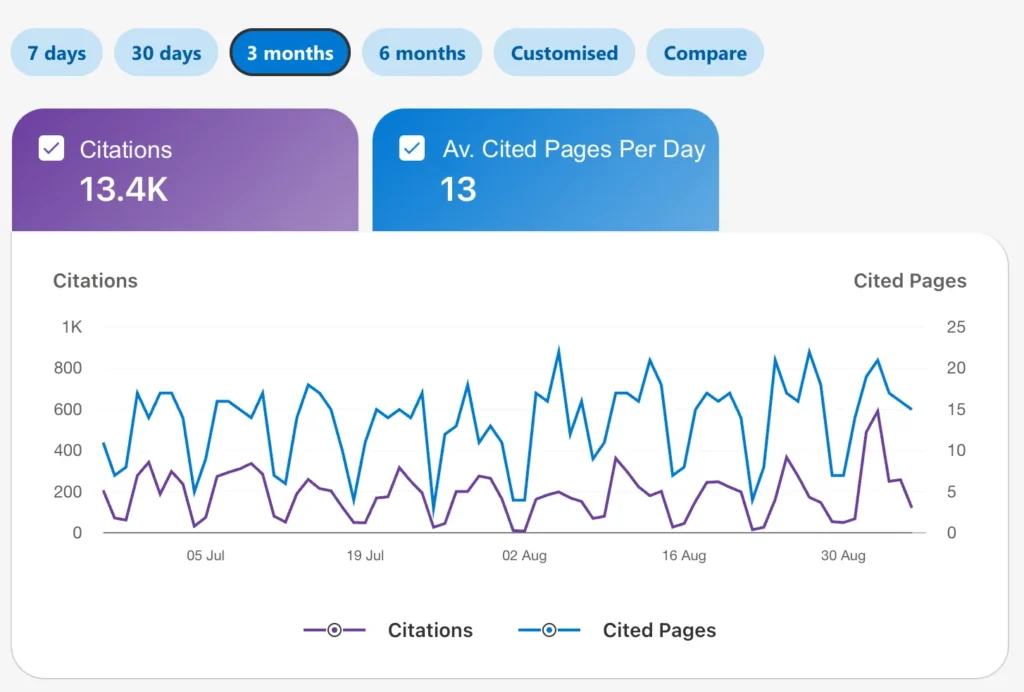
Yet over a three-month period, Bing reported around 13,400 citations from the site, with an average of 13 different pages being cited each day.
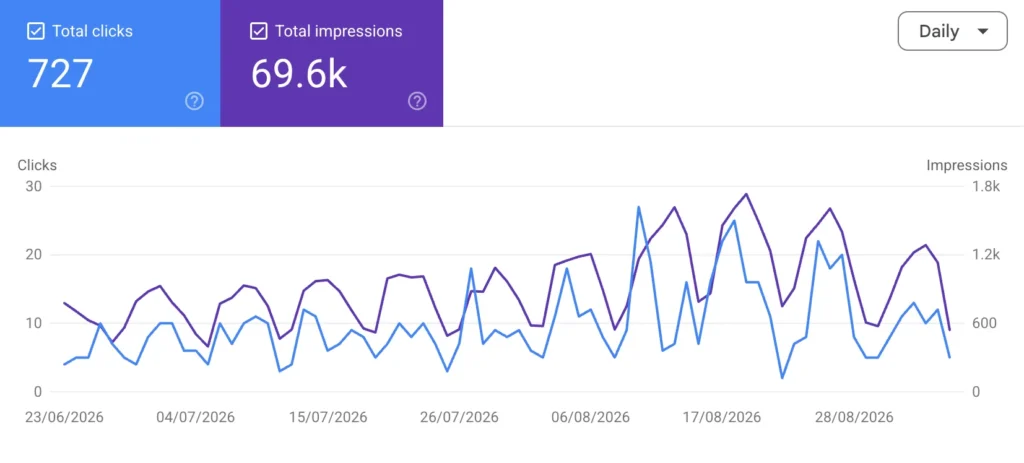
Then there’s Google. Over the same sort of three-month period, the site generated around 69,600 impressions in Google search, and more than 700 clicks. For a website with fewer than 100 pages, that caught my attention.
Nearly 70,000 Google impressions from a site with fewer than 100 pages
This is the bit I find especially interesting. I have another website of my own with approaching 1,000 pages. Yet this much smaller site, with fewer than 100 pages, is getting close to the same level of Google impressions.
That tells me something important. The number of pages on a website isn’t the interesting bit. The useful bit is whether those pages actually answer things people are searching for.
A website can have 1,000 thin, forgotten pages sitting there doing very little. Another can have 80 or 90 genuinely useful pages that keep appearing in searches, being clicked and being referenced.
More isn’t automatically better. Useful is better.
Facebook gives you numbers you can see
Part of the attraction of Facebook is that the feedback is immediate. You publish something, somebody likes it, someone else leaves a comment, another person shares it. You can literally sit there and watch the engagement count move. That makes it feel important.
Search works differently. Somebody might find a page you wrote four months ago. You don’t see them scrolling. You don’t get a notification when your page appears in a Google search. Bing doesn’t pop up and say:
“Martin, somebody found that article you wrote in May.”
It just happens, quietly, again and again. And that can make search traffic feel less exciting than social media, even when it’s doing far more useful work.
A Facebook post is temporary
This is one of the biggest differences. Most Facebook posts have a very short useful life. You can publish something genuinely valuable about your business and get a good response that afternoon, perhaps it keeps moving for a couple of days, then newer posts push it down. A week later, most people will never see it again. A month later, it’s practically archaeology.
Put that same useful information on your website and it behaves differently. It has a permanent address. Google can index it, Bing can index it, other websites can link to it, AI search tools can find it. Someone can discover it six months from now, or next year. That’s a very different return on the effort it took to create the content.
Where Facebook still earns its keep
I use Facebook a lot to promote local businesses. It can be brilliant for immediate visibility. A restaurant puts on a special menu, a shop launches something new, a local event is happening this weekend. Facebook can put that in front of thousands of people quickly. That’s useful.
The mistake is treating Facebook as the final destination. If I’ve spent time creating something useful, I’d rather publish the full version on a website first, then use Facebook to draw attention to it. The website becomes the permanent home. Facebook becomes one route into it. That way the work has more than one life.
Likes measure reaction. Search measures discovery
A like and a search impression aren’t directly comparable. They measure different things. But that’s precisely why I think businesses should stop obsessing over one and ignoring the other.
A Facebook like tells you somebody saw something and reacted to it. A Google impression tells you your page appeared when somebody searched for something relevant. A click tells you they chose your result. A citation suggests your content was considered useful enough to be referenced as part of an answer.
Those are different signals, and for a business trying to be found by people who don’t already follow it, some of them are considerably more valuable than a thumbs-up.
69,600 opportunities to be seen
Let’s keep the number in perspective. 69,600 Google impressions does not mean 69,600 visitors. I’m not going to play the usual marketing game of grabbing the biggest number available and pretending it means something else. An impression simply means that a page from the website appeared in a Google search result.
But that’s still nearly 70,000 occasions in three months where Google thought something on a small website with fewer than 100 pages was relevant enough to show. That’s worth paying attention to, especially when the site is also generating more than 700 actual clicks and thousands of Bing citations.
Forget the SEO waffle. This is what happens when a small website keeps publishing useful information.
Three decent articles a month can do more than people think
I think this is where small businesses sometimes give up before they’ve even started. They hear words like blogging, SEO, content marketing and now AI search optimisation, and assume they need to become publishers. They don’t.
This site isn’t producing 30 articles every month. It’s usually producing about three, some months a little more. But they’re adding to an existing body of useful content, and that’s important.
One decent article doesn’t have to transform a website overnight. It becomes another page that can be found, then another, then another. Over time, the website contains more answers, covers more subjects and gives search engines more reasons to surface it.
It’s not glamorous. It doesn’t give you instant applause. But it accumulates.
This is what social media numbers can hide
Imagine two businesses. One publishes almost everything directly to Facebook and gets a respectable amount of engagement. The other creates useful website content, then uses Facebook to promote it.
The first business might look more successful on Facebook: more likes, more comments, more activity. But six months later, most of that activity has disappeared into the timeline.
The second business has been quietly building something: pages, search visibility, clicks, citations, an expanding footprint across Google, Bing and whatever comes next. That’s harder to show in a screenshot of a Facebook post. But I’d argue it’s a much better place to be.
This is why I still care about websites
We’ve had years of people claiming websites are becoming less important. First social media was going to replace them, then apps, then Google Business Profiles. Now apparently AI is going to make websites irrelevant.
Except AI needs information from somewhere. Search engines need pages to index. AI search needs sources to cite. People still need somewhere to read the full information, check the details, understand what a business does and decide whether they trust it.
A useful website isn’t becoming obsolete. If anything, having useful, original and easily discoverable information on your own website is becoming more important. And those figures are a decent example of why.
Fewer than 100 pages.
Usually around three new articles a month.
Roughly 13,400 Bing citations in three months.
An average of 13 pages cited each day.
More than 700 Google clicks.
Around 69,600 Google impressions.
If your website isn’t doing this, I can help
This isn’t a huge business with a huge marketing budget. It’s a small business using a relatively modest budget carefully. That’s the point.
You don’t necessarily need to spend thousands every month on ads, endless social media content or some enormous SEO campaign. You need a website that’s useful, content that answers the right questions, and somebody who understands how to make the whole thing work together.
I’ve been doing this stuff for around 30 years. I should know what I’m doing by now.
So if most of your online marketing still comes down to posting on Facebook, counting likes and hoping somebody remembers you later, it might be worth looking at what your website is actually doing. Is it being found, appearing in search, bringing people in, being cited, helping attract new customers?
If the answer is mostly no, I can help with that. And I’m not talking about throwing money at pointless marketing activity just so somebody can send you a pretty monthly report. I mean making the budget you already have work harder.
Would I swap all the search exposure for a few thousand Facebook likes?
Absolutely not. Not even close.
Citations, Impressions and Why Your Website Still Matters
What’s the difference between a citation and a like?
A like tells you someone saw a post and reacted to it there and then. A citation means a search engine or AI tool considered your content useful enough to reference as part of an answer, often long after you published it. One is a reaction, the other is ongoing proof your content is doing its job.
Why do Google impressions matter if they don’t turn into clicks?
An impression means your page showed up when someone searched for something relevant, which is a signal Google thinks it’s a good match. Not every impression leads to a click, but a high number of them shows your content is consistently relevant to real searches, and that’s worth more than it looks on paper.
Do I need hundreds of pages for my website to get found?
No. A small site with fewer than 100 genuinely useful pages can generate similar search visibility to a much larger one with ten times the content. What matters is whether each page actually answers something people are searching for, not how many pages you’ve got sitting there.
How does AI search use website content differently to Google?
Google mostly shows your page as a result someone chooses to click. AI search tools go a step further and pull information directly from your pages to build an answer, sometimes citing you as the source. That means the actual wording and clarity of your content matters more than ever.
Is Facebook still worth using for a local business?
Yes, for immediate visibility. Facebook is brilliant for getting news about an offer, event or launch in front of people quickly. The mistake is treating it as the final home for your content, rather than a way to point people towards the full version on your website.
How often should I publish new content to get cited?
You don’t need a huge publishing schedule. Three decent, useful articles a month, added consistently over time, can be enough to build up a body of content that keeps getting found, clicked and cited. Consistency and usefulness matter more than volume.