You’d think losing 90% of your website traffic overnight would take something dramatic. A Google penalty. A hacked site. Some catastrophic technical failure.
It didn’t.
This business simply stopped putting content on their website. They kept hammering away on Facebook instead, same effort, just aimed at the wrong place. And when Facebook quietly tightened its organic reach (again), the whole thing fell apart in about a week.
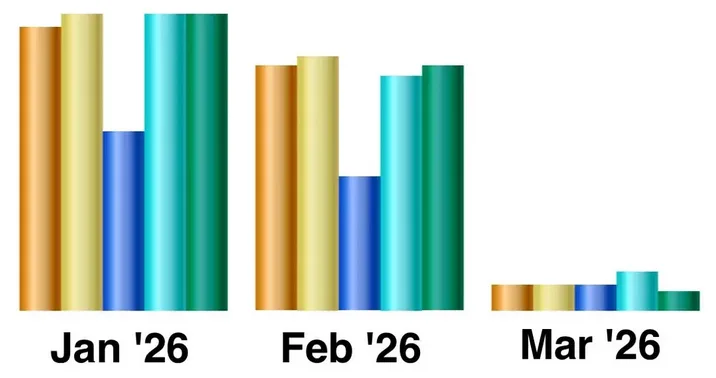
Look at the numbers. January: nearly 98,000 visits. February: a dip to 84,000. March: 8,013. That’s not a decline. That’s a collapse.
What actually happened here
SEO (Search Engine Optimisation) didn’t fail. Nobody flipped a switch. What happened was slower and more boring than that, which is exactly why most businesses miss it.
When you stop publishing content on your website, you stop appearing for new searches. Yes, your content keeps working – just a bit less. You stop creating those longer, more specific phrases people type when they’re properly looking for something.
And Google stops seeing signals that tell it your business is active and worth showing. As I said a moment ago; existing content keeps working but Google’s bot is thinking “why is there no new content here?” Trust, authority and credibility signals dried up.
At the same time, Facebook was doing what Facebook always does: showing your posts to fewer people unless you pay. So the casual clicks dried up. The “oh that looks interesting” taps from people scrolling on their lunch break, gone.
In this case, both things happened at once.
The website went quiet, and Facebook pulled the rug. The graph tells you the rest.
Most of that traffic wasn’t going to buy anything anyway
A big chunk of the traffic this business lost was never going to convert. It was people scrolling, people curious, people tapping a link because it popped up between a cat video and someone’s holiday photos while they were at the loo. That’s not buying intent. That’s killing time.
The visitors still arriving (lower for various reasons already mentioned) through search are a different breed. They’ve typed something specific into Google. They’ve probably seen this business name before – through previous searches not blooming Facebook (but sometimes Facebook). They’re further along in making a decision.
They don’t click for a browse.
They click because they’re close to buying something.
Don’t twist that into a comfort blanket
It’s tempting to hear “your remaining traffic is higher quality” and relax. Don’t.
Yes, the low-quality traffic fell away. Yes, the people still finding this business through search are more likely to act. But the total number of opportunities shrank too. Less content means fewer ways in.
This business didn’t swap bad traffic for good traffic. They just ended up with less of everything, and the junk fell off first.
The real problem was never Facebook
Facebook did what Facebook always does. It changed the rules. It will change them again next month and the month after that. Blaming Facebook for this is like blaming the weather for not owning an umbrella.
The real problem was building (and relying on) visibility on a platform someone else controls, while neglecting the one thing this business actually owns: their website.
If the time spent cranking out Facebook posts had gone into the website instead, regular blog posts (optimised, of course) answering questions real customers actually ask, pages that properly explain products and services, content that gets indexed by search engines and picked up by AI tools, the graph wouldn’t look like that. The drop wouldn’t have been so savage, because website content doesn’t vanish after 48 hours. It compounds. It builds. It keeps working months and years after you hit publish.
Something else has changed, and most businesses haven’t noticed
People don’t use the internet the way they did five years ago. They read summaries in search results. They see brand mentions in AI answers. They compare options without ever clicking through to your website.
Your content can be doing its job, influencing decisions, building familiarity, making your business the obvious choice, without ever registering as a “visit” in your analytics.
That’s uncomfortable if you’re checking your stats every morning. But it’s how things work now. The businesses that understand this are the ones creating content that works across search, AI tools, and direct visits. The ones that don’t are still wondering why their Facebook reach dropped again.
Stats are for egos. Sales are for business growth.
The credit card moment
Search traffic isn’t better because the people are smarter. It’s better because of timing.
Someone who finds you through search has most likely already looked around. They’ve compared. They’ve seen your name more than once. When they finally click through to your site, they’re not browsing. They’re deciding. That’s why fewer visitors from search can still produce solid results, because these are people with their hand near their wallet.
What this business should do now
The fix isn’t complicated. It’s just not instant.
- Start publishing on the website again.
- Answer the questions your customers actually ask.
- Build pages that explain what you do and why it matters.
- Stop treating Facebook as your shopfront and start treating it as what it is: a noticeboard in someone else’s building that they can take down whenever they fancy.
If even half the effort that went into Facebook had gone into the website over the past year, the March numbers would tell a completely different story. The drop would have been a dip, not a cliff. And recovery would already be underway.
Instead, the gap got exposed. And that’s the part most businesses would rather not think about.
Your Burning Questions About Website Traffic Drops, Answered
Why did this website’s traffic drop so suddenly?
The business stopped publishing content on their website while continuing to focus on Facebook. When Facebook reduced organic reach at the same time, both sources of traffic fell away within weeks. It wasn’t a penalty or technical issue, it was a content and strategy problem.
Does less traffic always mean fewer customers?
Not necessarily. Much of the lost traffic came from casual social media clicks with low buying intent. Search traffic tends to bring visitors who are actively looking for a product or service, so fewer visits can still produce results. But losing volume also means fewer total opportunities, so it’s not something to shrug off.
Is Facebook still worth using for business marketing?
Facebook can play a supporting role, but it should never be your main source of visibility. You don’t own your Facebook page in any meaningful sense, and the platform changes its rules constantly. Your website is the only online asset you fully control, and content published there keeps working long after a Facebook post has been buried.
How does website content help with AI search tools?
AI search tools like Google’s AI Overviews and ChatGPT pull information from well-structured website content. If your site has clear, helpful answers to common questions, it can be referenced in AI-generated summaries and answers, giving your business visibility even when people don’t click through to your site directly.
How long does it take to recover from a traffic drop like this?
It depends on how quickly you start publishing useful content again and how competitive your market is. Most businesses see meaningful improvements within three to six months of consistent content creation. The key is regularity and relevance, not volume for the sake of it.