A recent survey of 500 marketers and business owners found original research (82%) and comparison content (76%) perform best for AI search citation, while video sits at just 2%. Social media doesn’t appear as its own category at all, the closest entry is community and forum participation at 28%. Google may still show a Facebook page for a direct business name search, but that’s unrelated to whether AI tools like ChatGPT or Gemini treat your content as a source worth citing for broader questions.
The Chart That Proves Facebook Was Never the Best Business Plan
Original research and proper comparison content top a new survey of what AI search tools actually cite, at 82% and 76%. Video sits at the bottom on 2% (although videos are worth sharing publicly on YouTube). Social media doesn’t get a line of its own at all. The nearest thing to it, community and forum participation, sits at 28% and isn’t really the same category.
If your content strategy lives mainly on Facebook, this chart is telling you something worth thinking about.
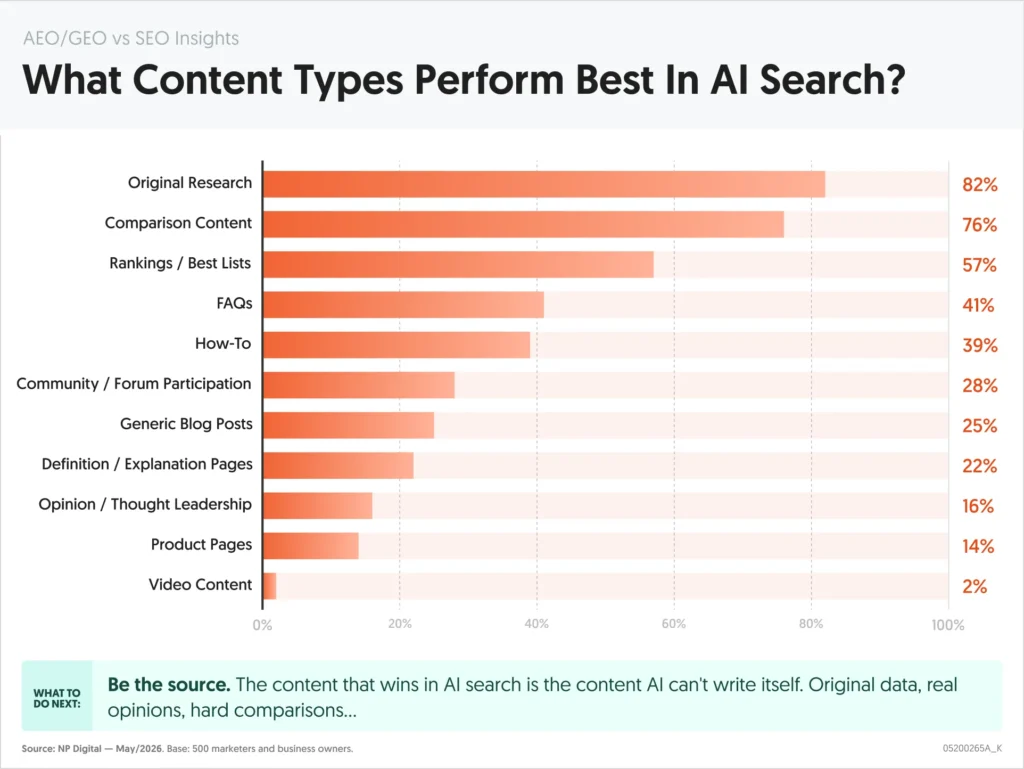
I’ve had this conversation with more local business owners than I can count, usually some version of “but everyone’s on Facebook.” They are. That’s never been the question. The question is whether being on Facebook gets your business found when someone asks an AI tool a question instead of typing it into Google, and the answer, going by this latest data from NP Digital, is no, not really.
What The Numbers Are Actually Telling You
Look at what tops the list. Original research at 82%. Comparison content at 76%. Rankings and best lists at 57%. These all share something obvious once you notice it: they’re things AI can’t write itself.
ChatGPT or Gemini can summarise a topic in seconds, but it can’t invent a genuine customer comparison you’ve actually done, or original data from your own business, or a ranking based on real experience rather than scraped opinion. That’s the entire point of the line at the bottom of the chart: be the source AI can’t replicate.
The Stuff AI Can’t Write Itself
Now look at what’s missing. No social media category. Not Facebook, not Instagram, not TikTok, none of it. I’d wager that’s not an oversight, it’s because AI tools don’t cite social posts the way they cite a proper article.
A Facebook post has no permanence, no structure, and nothing for a machine to extract cleanly. It scrolls past in two days and serves the algorithm, not the search engine, and certainly not an AI assistant trying to answer someone’s question with a credible source behind it.
Where Social Media Should Have Been On This Chart
I know what some of you are thinking. Google still shows my Facebook page when someone searches my business name. True, and that’s worth keeping, because it’s still a visible result in a normal search. But that’s an entirely different mechanism to what this chart is measuring.
Showing up as a blue link because someone searched your exact business name isn’t the same as being the source an AI tool reaches for when someone asks a broader question like “who’s a good plumber in Louth” or “what should I look for in a wedding photographer.” For that, you need something with actual substance behind it, sitting on a website, structured so it can be found and quoted.
A Blue Link Is Not The Same As A Citation
This is where the work I do for clients comes in, and I’ll be straight about it because pretending otherwise helps nobody.
Getting cited by AI tools isn’t about hoping a Facebook post catches the algorithm on a good day. It’s a deliberate process: answer a real question directly near the top of a page, back it with credentials a reader (or a machine) can verify, and structure it so the content can be lifted cleanly into an answer.
None of that happens on a platform built for scrolling past, however good your engagement numbers look in the moment.
How I Build Content That Gets Cited Instead Of Scrolled Past
None of this means abandon Facebook entirely. It still has its place for word of mouth and local visibility among people already following you. What it means is stopping the habit of treating Facebook as the whole strategy, because the data is fairly blunt about where it actually sits. Original research and comparison content are doing the heavy lifting in AI search. Video is barely registering. And social media isn’t even on the chart to argue about.
Facebook Still Has A Job, Just Not This One
If you want your business to show up when someone asks an AI tool a real question, the answer isn’t another Facebook post. It’s something written down properly, on your own site, that says something nobody else has bothered to say.
What This Chart Actually Means For Your Marketing
Why isn’t social media on this chart at all?
Social media posts don’t offer AI search tools anything stable to cite. They lack permanence and structure, and they’re built for a scrolling feed rather than a searchable answer. The closest category on the chart, community and forum participation, measures something different to a branded Facebook page.
Does this mean Facebook is a waste of time for a local business?
Not entirely, Facebook still has a role for local word of mouth and staying visible to people already following you. The issue is treating it as your whole strategy, when the data shows it carries almost no weight for AI search citation compared with original research or comparison content.
If Google still shows my Facebook page in search, doesn’t that prove it works?
That’s a different mechanism entirely. Google showing your Facebook page for a direct name search is just matching your brand to your known profiles. It has little to do with whether an AI tool treats your content as a credible source when someone asks a broader question without naming your business.
What should a local business actually do with this information?
Move genuine effort toward content AI tools can’t write themselves, original research, honest comparisons, and a website structured so that content can be found and cited cleanly. That’s a more reliable route to AI search visibility than relying on social posts that vanish from a feed within days.