If you are anything like me – bashing away at the keyboard for several hours a day and keeping up with everything when you get chance – your AI toolbox is most likely crammed.
Between ChatGPT, Claude, Gemini, Perplexity, and even Meta’s Llama, there seems to be no shortage of large language models (LLMs) offering something new and innovative.
And yet, every so often, a new contender pops up that demands a closer look. Today, that contender is DeepSeek V3 – an multimodal reasoning LLM boasting a jaw-dropping 671 billion parameters. Oh, and it’s ‘open source’ – for anyone who cares.
Open source refers to software whose source code is freely available for anyone to view, modify, and distribute.
Do we really need another LLM?
Personally, I don’t think I do.
It feels like the LLM market is saturated with tools, many of which overlap in capabilities, adding complexity and decisions rather than value to my workflow.
Just like the early days of internet service providers, where the market eventually settled as competition thinned out, I’m hopeful the AI tool market will follow suit with the truly valuable tools standing out, and the overwhelming noise will fade away.
We can hope.
The New Kid On The Block: DeepSeek V3
DeepSeek isn’t just another LLM – it’s a testament to how constraints can drive innovation. Despite US export restrictions, the company developed a model that rivals industry leaders like OpenAI and Google on a fraction of the usual training costs. I’m sure you’ve heard of the hundreds of billions poured into OpenAI etc?
DeepSeek’s Key Achievements
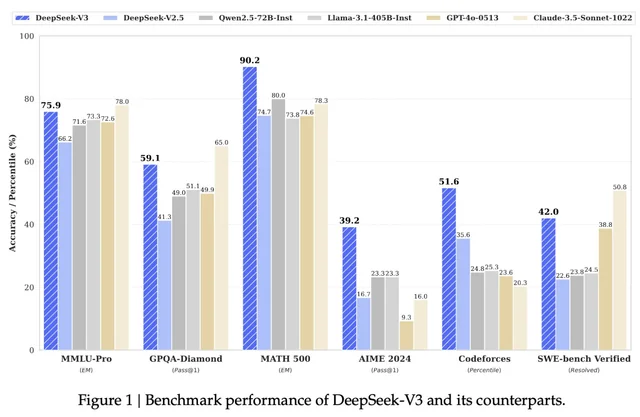
- Efficiency: Training a 671-billion-parameter model using only 2,048 GPUs over 57 days is groundbreaking.
- Performance: Scoring 92% on HumanEval (programming) and 85% on MATH 500 highlights its precision in technical tasks.
- Endorsements: Meta’s Yann LeCun praised it as “excellent,” underscoring its quality and impact.
But is it free? While many, in their clickbait headlines, claim DeepSeek is free, the reality is slightly different. It’s low-cost, not free, with aggressive pricing that undercuts competitors but still requires payment for significant usage. Fairly standard really.
This misconception about free, which is typical these days (get started for free must be one of the most used lines of text), fuels some of the excitement but deserves clarification.
DeepSeek’s innovation is undeniable and worthy of a hat tip, but for me, tools like this need to address specific gaps or streamline workflows to warrant adoption.
I remain cautious – at least until I see how it performs in real-world scenarios.
The Fatigue of Too Many Tools
Decision fatigue is real.
Not just with AI tools but with apps and services for everything. This constant influx of options chips away at the ability to focus on the tools that truly matter, making it harder to streamline workflows and maintain productivity.
Every time a new LLM lands on the scene, it demands attention and gobbles up our time doing testing and evaluation.
Although I mostly use ChatGPT (yes, paid, gold star) I’ve tested the other key players – some more than others – and even dabbled with Meta’s Llama; even downloaded the open-source version, and given it a whirl. The conclusion? It’s good – but not good enough to replace my go-to, ChatGPT.
Adding another tool to the workflow often feels more like a burden than a blessing. Juggling tools for brainstorming, research, reasoning, structuring content, or exploring other perspectives leads to a scattered workflow that slows productivity and creates unnecessary complexity.
This isn’t to say DeepSeek’s features aren’t exciting. If everything I’ve read is true, how could we knock it? That said, unless a tool offers a clear, undeniable advantage, I’m left wondering: do I need it enough to invest my time and energy into learning it?
More often than not, the answer is no.
Why Caution is Warranted
While it seems that DeepSeek was launched on a shoestring compared to other LLMs, another layer to my hesitation is trust. DeepSeek originates from China, a region that’s often met with scrutiny when it comes to data privacy and transparency.
The many public and high-level debates over companies like TikTok or Huawei illustrate why some users remain cautious, as these controversies have significantly shaped public trust in technology and raised awareness about potential risks. They’ve also led to heightened scrutiny of tech companies across the board, encouraging users to demand greater transparency and accountability from all platforms.
Oh, and this didn’t do anything to boost my trust… I tried to sign-up using a.uk email address and was unceremoniously told to bugger off.

For me, trust is non-negotiable. When I use an AI tool – any tool, in fact, I need to feel confident that my data is safe and the model is transparent about its practices. This is the reason I have dumped apps in the past that keep all data on their servers preventing us from having a fully offline copy. Yes, I’m looking at Notion and the like.
The Other Side: Are These Concerns Fair?
Open-source projects like DeepSeek do offer a level of scrutiny, but whether that’s enough to overcome broader concerns remains an valid question in my book.
That said, it’s worth asking: are my concerns entirely justified? Open-source models are, by their nature, subject to global review. The community’s ability to look at the code and processes could mitigate many of the risks I’m worried about.
Additionally, dismissing tools based on their origin might limit exposure to genuine innovation. The Far East has consistently driven technological progress, and refusing to engage with tools like DeepSeek could mean missing out on valuable advancements.
Most of our devices are made in China, and we throw all our details, including confidential stuff, into them without any hesitation, don’t we?
Finally, let’s not pretend data privacy concerns are exclusive to certain regions. Western tech giants like Facebook and Google have also faced scrutiny over data privacy, proving that these concerns aren’t unique to any one region. It’s essential to hold all tools to the same standard of trust and fairness.
Why ChatGPT Still Leads My Workflow
Despite the noise and competition, I keep coming back to ChatGPT. It balances performance, ease of use, and reliability in a way no other model has managed – yet.

While I’m open to experimenting with new tools, they need to provide a compelling reason to disrupt my workflow and, so far, few have.
DeepSeek’s stats are impressive – especially considering the groundbreaking work they’ve done under constraints. Their ability to train a 671-billion-parameter model with limited resources is remarkable and highlights how innovation can thrive under pressure. However, despite these achievements, they don’t solve the core issues I face daily. I need tools that streamline my work and reduce decision fatigue, not ones that add complexity.
So, for now, ChatGPT remains unmatched in delivering the consistency and simplicity I rely on.
Lessons for AI Users
What can we take away from this?
The AI landscape is evolving rapidly, and it’s easy to get caught up in the excitement of new tools. But before diving in, ask yourself:
- Does this tool solve a specific problem I’m facing?
- Will it genuinely improve my workflow, or just add to the noise?
- Can I trust it with my data and processes?
It’s not about dismissing innovation but about being selective. Sometimes, the best tool is the one you already know inside out.
Simplifying in a Complex Landscape
DeepSeek V3 might be a breakthrough for some, but for me, right now, it’s another reminder of the importance of simplicity—and not jumping on every bright and shiny tool.
With so many LLMs vying for attention, the real challenge isn’t finding a better tool. It’s knowing when to say, “Enough is enough.”
For now, I’ll stick with what I know works – and doesn’t require me to have an approved email domain.
But who knows?
If DeepSeek can prove its transparency and integrate seamlessly into existing workflows, I might just revisit it.
Until then, my toolbox is full, and I’m keeping my focus where it belongs: on creating, not complicating.